
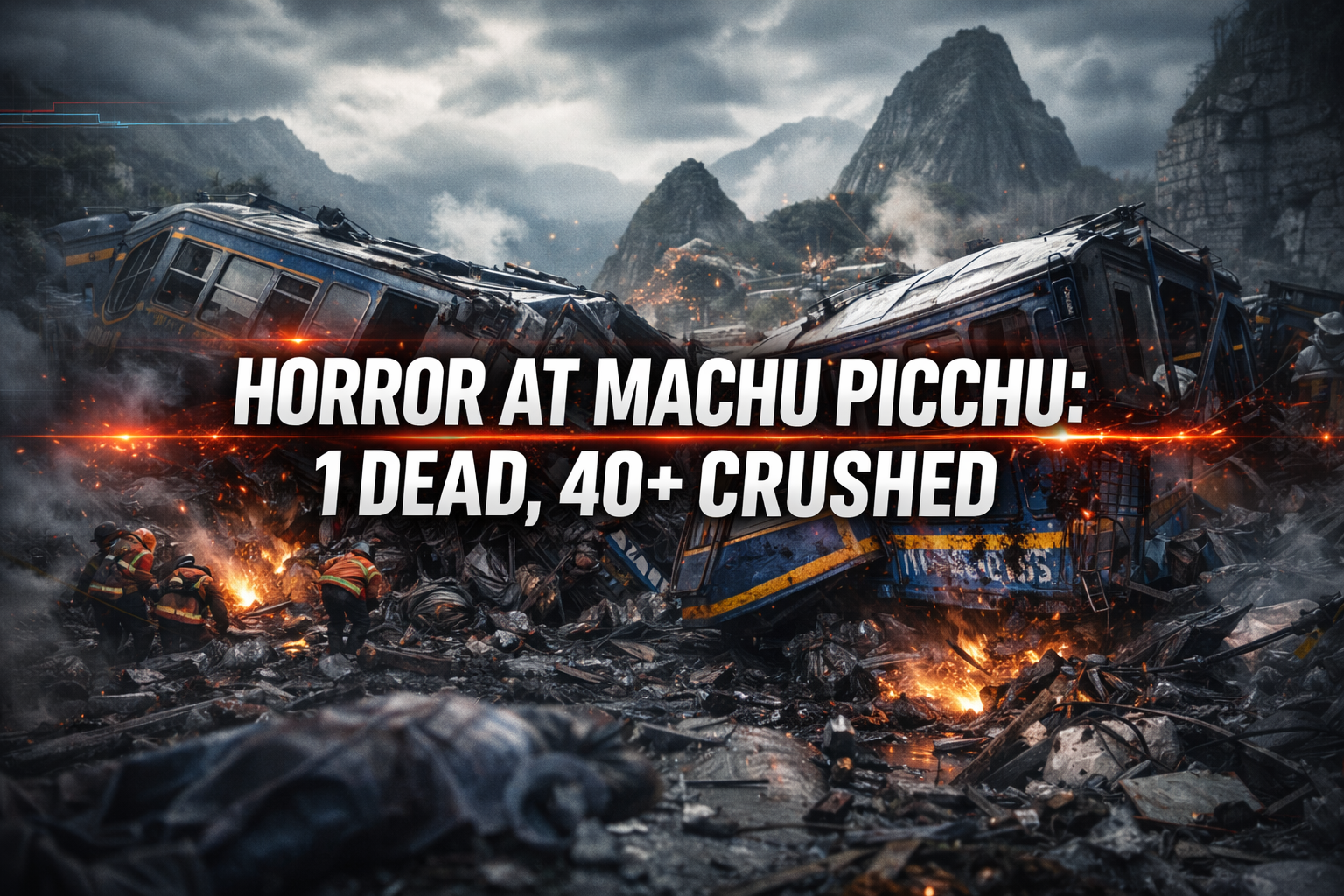
Machu Picchu Train Crash: Tragic Collision Kills 1, Dozens Injured
The mist-shrouded peaks of the Andes, usually a symbol of spiritual serenity, became the backdrop for a waking nightmare on Tuesday. A Machu Picchu train crash has sent shockwaves through the global travel community, leaving at least one person dead and over 40 others battling significant injuries. For the thousands of tourists who flock to the 15th-century Inca citadel daily, the journey is meant to be a once-in-a-lifetime pilgrimage; instead, for those aboard the PeruRail and Inca Rail locomotives near Qoriwayrachina, it became a terrifying struggle for survival.
The collision occurred at midday, a peak hour for the narrow, single-track line that serves as the lifeblood for the region’s tourism. As the two massive steel engines crumpled into one another, the silence of the Sacred Valley was shattered by the screech of tearing metal and the cries of the wounded. This wasn’t just a mechanical failure; it was a systemic collapse in one of the world’s most monitored transit corridors. As rescue teams scrambled across rugged, roadless terrain to reach the site, a haunting question emerged: How could such a catastrophic head-on collision happen in the age of modern GPS and advanced signaling?
The victim, identified as a dedicated railway conductor, represents the human cost of a logistics system stretched to its breaking point. With American, European, and local tourists among the injured, the “Lost City of the Incas” is currently facing its darkest hour in recent memory. Ready for the scoop?
News Details: The Narrative Behind the Machu Picchu Train Crash
The timeline of the Machu Picchu train crash reads like a thriller gone wrong. At approximately 12:30 PM, a PeruRail train departing from the Ollantaytambo station collided head-on with an Inca Rail locomotive traveling in the opposite direction. The impact occurred near the archaeological site of Qoriwayrachina, a remote area where the tracks are hemmed in by sheer rock faces on one side and the rushing Urubamba River on the other.
Witnesses describe a scene of pure chaos. Glass shards from the panoramic windows—designed to give tourists a “perfect view” of the Andes—became lethal projectiles. “We felt a massive jolt, and then everything went black as the dust rose,” shared one survivor. Because there are no roads leading directly to the crash site, emergency responders had to be dispatched via specialized rail cars, a delay that felt like an eternity for those lying wounded on the ballast.
The Viral Takeaways from the Disaster:
- Fatal Impact: The conductor of the PeruRail locomotive, Roberto Cardenas, was killed instantly upon impact.
- International Toll: The US Embassy has confirmed multiple American citizens are among the 40+ injured.
- Logistical Nightmare: Rescue efforts were hampered by the lack of road access; victims had to be evacuated back to Cusco via rail and then ambulance.
- Systemic Failure: The crash happened on a “single-track” line, where precise timing and communication are the only things preventing disaster.
- Service Suspension: All rail traffic to and from the citadel has been halted indefinitely, leaving thousands of travelers stranded in Aguas Calientes.
- The “Protest” Factor: Unconfirmed reports suggest recent local protests near the tracks may have disrupted normal signaling protocols or scheduling.
Was this a case of human error, or did the signaling equipment fail in the thin mountain air? Why were two trains permitted on the same stretch of single-track rail simultaneously? Could the pressure of high-season tourist numbers have led to a fatal shortcut in safety checks? And finally, is the most famous landmark in South America actually safe to visit?
Impact & Analysis: Unpacking PeruRail Inca Rail collision and Machu Picchu train crash
The PeruRail Inca Rail collision is more than a local tragedy; it is an international incident that threatens the very foundation of Peru’s tourism economy. As investigators from the Ministry of Transport and Communications (MTC) descend on the ruins, the focus is shifting toward the infrastructure of the Ferrocarril Transandino.
The Pros & Cons of the Current Transit Model
| Pros of the Rail System | Cons & Risks Revealed by the Crash |
| Environmental Protection: Restricts heavy vehicle traffic near the UNESCO site. | Single-Track Vulnerability: No room for error; one mistake causes a head-on impact. |
| Economic Engine: Generates millions in revenue for the Cusco region. | Monopolistic Fragility: Two companies share one track, creating competitive pressure. |
| Aesthetic Value: Offers world-class views that attract 1.5 million visitors annually. | Rescue Inaccessibility: Remote geography means medical help is always delayed. |
Synthetic Audience Reactions: The Digital Pulse
- “I was supposed to be on that train tomorrow. My heart is in my throat. Is the trek the only safe way now?”
- “This is what happens when you prioritize profit and ‘scenic views’ over modern double-tracking and automated braking.”
- “Praying for the conductor’s family. He was just doing his job in one of the toughest terrains on Earth.”
- “Wait, I thought these trains had GPS tracking? How do they not see another locomotive coming at them?”
- “Peru’s tourism is already struggling; this might be the final blow for many international travelers.”
Expert Views & The Truth of the Machu Picchu train crash
To understand the Machu Picchu train crash, we must look beyond the twisted metal. Industry experts suggest that the “bottleneck” effect of the Aguas Calientes route has been a ticking time bomb for years.
- Transport Safety Analyst, Dr. Elena Vargas: “The Andean rail system relies on a manual-heavy dispatch system that is archaic for the volume of passengers it carries. Until an automated positive train control (PTC) system is implemented, the risk of a head-on collision remains statistically high.”
- Tourism Policy Expert, Marcus Thorne: “Machu Picchu is a ‘bucket list’ item that is being over-monetized. When you have two private entities like PeruRail and Inca Rail competing for slots on a single track, safety margins often get thinner during the peak holiday seasons.”
- Local Guide, Carlos Huaman: “The mountains are unforgiving. We have seen landslides and protests, but a head-on collision is a failure of the soul of the railway. We have lost a brother in Roberto Cardenas today.”
The Hidden Insights of the Machu Picchu train crash
Behind the scenes, local authorities are looking into whether “phantom stops” caused by local protesters may have played a role. On the day of the Machu Picchu train crash, small groups of locals were reportedly blocking parts of the track nearby to protest ticket prices. While not a direct cause, these disruptions often force trains into “unscheduled holds,” which can throw the entire day’s carefully timed “meet-and-pass” schedule into a state of lethal confusion.
FAQ Section: Understanding the Disaster
Q: What caused the Machu Picchu train crash?
A: While a formal investigation is underway, the crash was a head-on collision between a PeruRail and an Inca Rail train. Preliminary theories suggest a signaling failure or a miscommunication regarding track clearance on the single-line section.
Q: Are there still people stranded at Machu Picchu?
A: Yes. Because the rail is the primary way in and out of the site, thousands of tourists were initially stranded in Aguas Calientes and Ollantaytambo. Evacuation trains have since been prioritized for the injured.
Q: Is it safe to book a trip to Machu Picchu right now?
A: Rail services are currently suspended. Travelers are advised to check with their tour operators. The “Inca Trail” trekking route remains open but is physically demanding.
Q: Who were the victims of the crash?
A: One conductor was killed. Among the 40+ injured are tourists from the United States, Europe, and South America, as confirmed by the Cusco Health Directorate.
Q: Has this happened before?
A: Minor derailments due to landslides are common in the Andes, but a head-on collision between the two major carriers is an extremely rare and severe safety breach for this route.
Conclusion
The Machu Picchu train crash serves as a grim reminder that even the most magical journeys are tethered to the harsh realities of infrastructure and human error. As the families of the victims mourn and the injured begin their long road to recovery in Cusco’s clinics, the Peruvian government faces a reckoning. The “Sanctuary of the Incas” deserves a transit system that is as robust and enduring as its stone walls.
For now, the tracks are silent. The vibrant blue and yellow carriages sit mangled in the Andean mud, a stark contrast to the majesty of the peaks above. This tragedy must be the catalyst for change—not just for the sake of tourism, but for the safety of every worker and traveler who traverses the Sacred Valley.
Drop your thoughts & share!
Source Note: Ministry of Transport (MTC) Peru, Cusco Regional Police, AP/Reuters Dispatch.
Date: December 31, 2025
By: Aditya Anand Singh