
Samsung Odyssey 3D 6K Monitor: Why Your Screen Is Now Obsolete
The luminous glow of a standard 2K display suddenly feels like a relic from a forgotten era. This week, at a closed-door reveal ahead of CES 2026, the tech giant shattered the boundaries of human perception with the Samsung Odyssey 3D 6K monitor, a device that doesn’t just display images—it breathes life into them. We have reached a technological singularity where the monitor is no longer a window, but a doorway. With the world’s first glasses-free 3D 6K experience and a staggering 1040 Hz mode on its sibling, the Odyssey G6, Samsung isn’t just leading the market; they are terraforming the entire landscape of digital immersion. This is the moment the “screen” died and the “environment” was born. Ready for the scoop?
News Details: The Narrative Behind Samsung Odyssey 3D 6K Monitor
The narrative behind the Samsung Odyssey 3D 6K monitor is one of sheer, unadulterated engineering ambition. For years, “glasses-free 3D” was a gimmick relegated to handheld consoles and experimental kiosks, plagued by narrow viewing angles and dizzying “sweet spots.” Samsung has dismantled this limitation using an advanced lenticular lens layer paired with real-time AI eye-tracking. As your head moves, the monitor’s sensors track your pupils with sub-millimeter precision, adjusting the perspective of the 6K light field to ensure that a sword tip in Stellar Blade or the crumbling ruins in Lies of P: Overture appear to physically occupy the space between the panel and your nose.
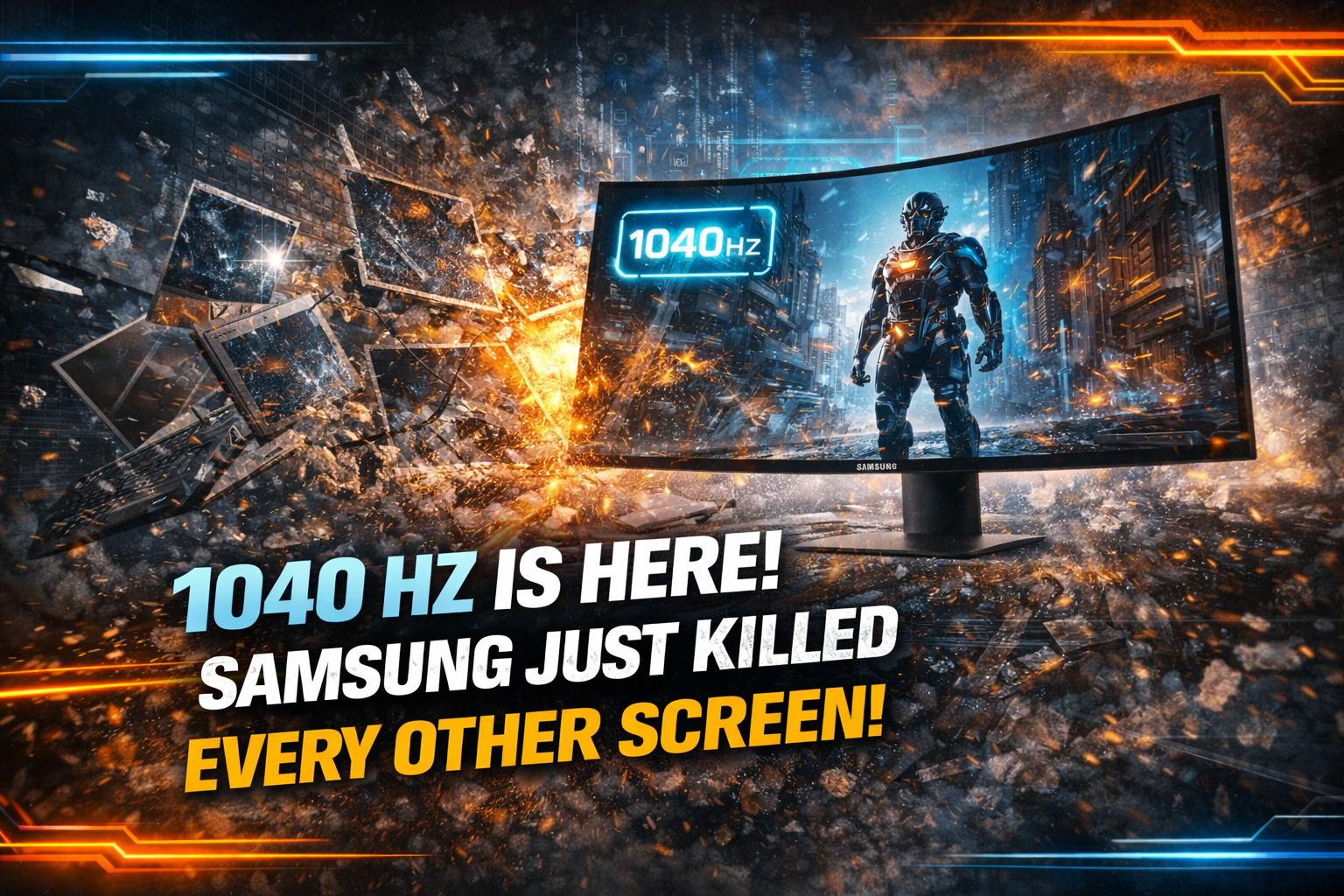
But the 32-inch Odyssey 3D is only half of the story. Its counterpart, the 27-inch Odyssey G6, has introduced a reality-warping 1040 Hz mode. While the human eye’s ability to perceive such speeds is often debated, the mathematical reality of a 0.96ms frame time cannot be ignored. In competitive esports, where victory is measured in the nanoseconds of a flick-shot, this monitor provides a level of motion clarity that makes traditional 240Hz displays look like flickering stop-motion animation.
How can a single IPS panel handle 1040 frames per second without melting? Is the 6K resolution of the Odyssey 3D overkill for a 32-inch screen, or is it the mandatory tax for a convincing stereoscopic effect? Will developers embrace the native 3D API, or will this remain a luxury “halo” product for the elite? The reveal has left the industry breathless, proving that Samsung’s R&D labs are currently operating in a future the rest of us are only starting to imagine.
Viral Takeaways from the Odyssey 2026 Launch:
- Glasses-Free 3D: The G90XH model uses AI eye-tracking for seamless, 3D depth without headsets.
- The 1040 Hz Speed Demon: The Odyssey G6 (G60H) reaches a world-first 1040 Hz refresh rate in HD mode.
- 6K Native Resolution: The Odyssey 3D boasts a massive 6,144 x 3,456 resolution for ultra-fine detail.
- Dual Mode Flexibility: The G6 switches between QHD @ 600Hz for visuals and HD @ 1040Hz for raw speed.
- DP 2.1 Integration: Support for UHBR20 ensures uncompressed bandwidth for 6K and ultra-high Hz.
- AI 2D-to-3D Conversion: Legacy games can be upscaled into 3D using Samsung’s onboard spatial processor.
- Studios Onboard: Partnerships with Nexon and Neowiz ensure day-one 3D optimization for major titles.
Impact & Analysis: Unpacking Motion Clarity Revolution and Glasses-Free 3D Tech
The Samsung Odyssey 3D 6K monitor represents the pinnacle of the Motion Clarity Revolution. For decades, the industry chased “Resolution,” then “Color Depth,” and finally “Refresh Rate.” Now, we are entering the era of “Spatial Presence.” By combining 6K density with 3D depth, Samsung is solving the “immersion gap.” In traditional 2D gaming, your brain is always aware of the flat plane. With Glasses-Free 3D Tech, the brain’s vestibular and visual systems are tricked into a state of “presence,” reducing the cognitive load required to judge distance and scale in a digital world.
Simultaneously, the 1040 Hz mode on the G6 addresses the final boss of monitor tech: persistence blur. Even at 360Hz, fast-moving objects leave a faint trail due to the way our eyes track across the screen. At 1040 Hz, that trail effectively vanishes. This isn’t just for “pro gamers”; it’s for anyone who wants a digital experience that mirrors the fluidity of natural human sight.
Long-Term Pros & Cons of the New Odyssey Lineup:
Pros:
- Ultimate Immersion: The 3D effect provides a genuine competitive advantage in judging depth and terrain.
- Future-Proofing: 6K resolution and DP 2.1 mean these monitors won’t be obsolete for at least a decade.
- Versatility: Dual Mode allows users to switch between a cinematic 6K workstation and a 1040Hz gaming beast.
Cons:
- Hardware Requirements: To drive a 6K 3D display or 1040 Hz, you will likely need a multi-thousand-dollar GPU setup.
- Sweet Spot Limits: While improved, eye-tracking 3D is still primarily a single-user experience.
- Niche Appeal: The 1040 Hz mode requires dropping resolution to HD, which may turn off visual enthusiasts.
What-if Analysis: The Extreme Future Outcome
In the most extreme outcome, the success of the Odyssey 3D marks the beginning of the end for VR headsets. If you can achieve 90% of the “depth” and “scale” of a VR headset without the weight on your face or the isolation from your surroundings, the “spatial monitor” becomes the primary interface for the Metaverse. By 2030, we could see entire offices replaced by a single 6K 3D glass panel that projects virtual coworkers into the room with you.
Social Media Fan Reactions:
- @TechLord_V: “1040 Hz? My eyes can’t even see my own bank account balance that fast. Samsung is insane. #Odyssey2026”
- @GamerGirl_Lexi: “Glasses-free 3D is the dream. I hate wearing a headset for 4 hours. If this works for Stellar Blade, I’m sold.”
- @EsportsPro_Focus: “QHD at 600Hz is the real winner here. 1040Hz is cool for the flex, but 600Hz at 1440p is the endgame.”
- @MonitorNerd: “6K on a 32-inch? The pixel density is going to be godly. Apple’s Pro Display XDR finally has competition.”
- @Dev_spatial: “We’ve been waiting for a native 3D API on a mainstream monitor. This changes how we design levels forever.”
Expert Views & The Truth of DisplayPort 2.1 Bandwidth
Display experts argue that the Samsung Odyssey 3D 6K monitor is the first true test of DisplayPort 2.1 Bandwidth. To move the sheer volume of data required for 6K at high refresh rates, Samsung is utilizing UHBR20 (Ultra-High Bit Rate), which offers up to 80Gbps. This is a “Truth” often ignored in marketing: you cannot run these monitors at their peak without the latest high-end GPUs. Expert views suggest that while the 1040 Hz mode is a “hero spec,” the 600 Hz native QHD performance is the more technically impressive feat, as it pushes the limits of IPS pixel response times without introducing ghosting.
The Hidden Insights of Samsung Odyssey 3D 6K Monitor
A hidden insight behind the Samsung Odyssey 3D 6K monitor is its “Stereoscopic AI Engine.” Behind the scenes, the monitor isn’t just displaying two images; it’s using a neural processing unit to “fill in” the gaps between the views. This prevents the “paper cutout” effect seen in older 3D tech, where objects looked like 2D layers stacked in a box. Furthermore, the eye-tracking system is sophisticated enough to compensate for users wearing glasses or contacts, a hurdle that previously killed glasses-free 3D in the mobile market.
Conclusion: The Future Implications of Samsung Odyssey 3D 6K Monitor
The future implication of the Samsung Odyssey 3D 6K monitor and the 1040 Hz G6 is a fundamental shift in how we define “visual quality.” We are moving away from static specifications toward “perceptual perfection.” Samsung has proven that there is still massive room for innovation in the flat-panel market, even as AR and VR attempt to take over.
By 2027, the technologies debuted here—the 1040 Hz motion clarity and the eye-tracked spatial depth—will likely trickle down into more affordable models. For now, they serve as a beacon of what is possible when a company refuses to accept the status quo. Whether you are a competitive athlete seeking the lowest possible latency or a cinematic dreamer looking to lose yourself in a 6K world, the new Odyssey lineup is a testament to the fact that the future of sight is here, and it is more vivid than we ever dared to hope.
Drop your thoughts & share!
Source Note: Samsung Global Press Release, December 23, 2025; CES 2026 Early Preview.Updated Date: December 24, 2025, By Aditya Anand Singh